Foreign Body Investigation , Microscopy & Rheology
UKAS Accredited Foreign Body Identification Service
Foreign Body Identification Services
Protecting Your Brand. Protecting Your Reputation.
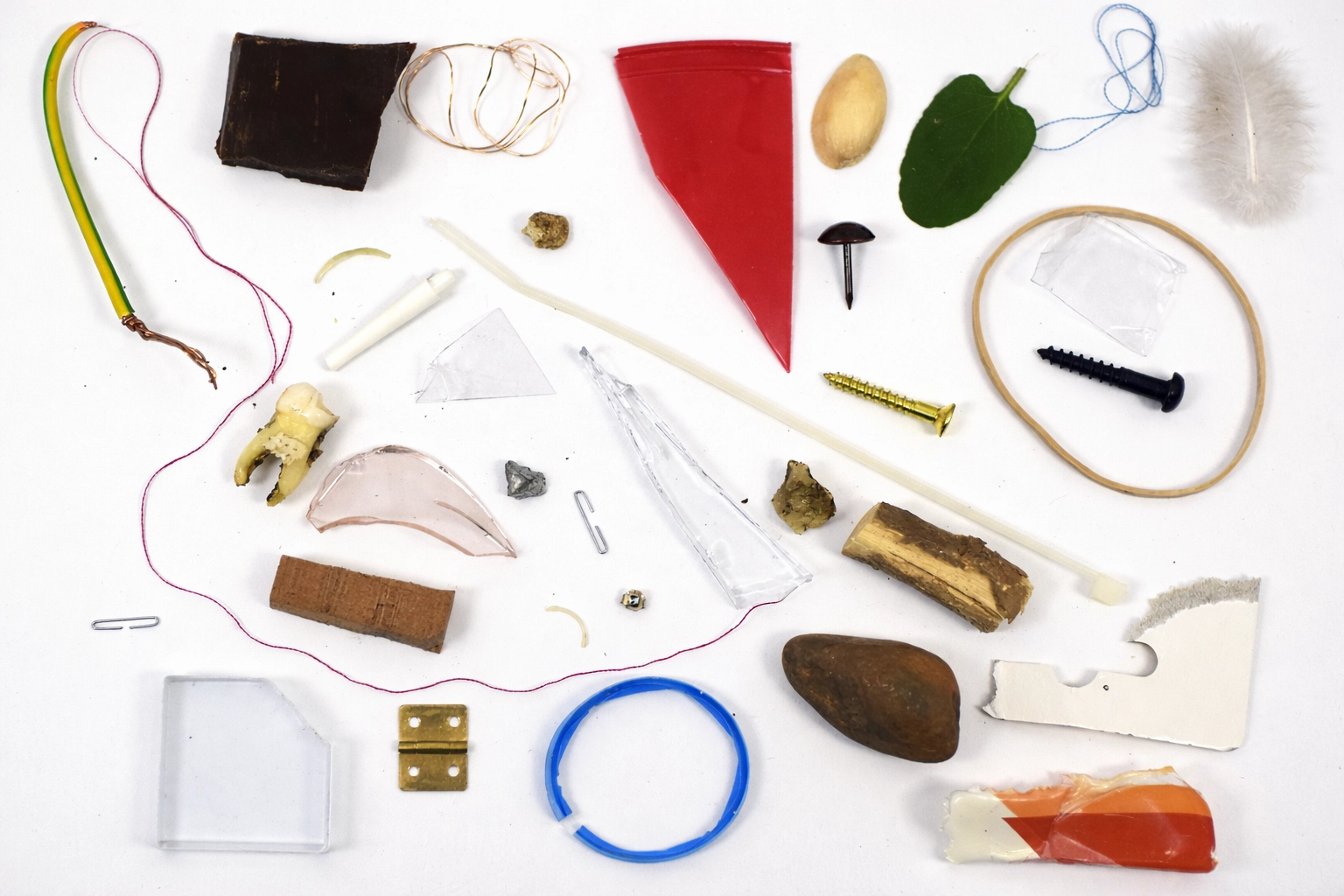
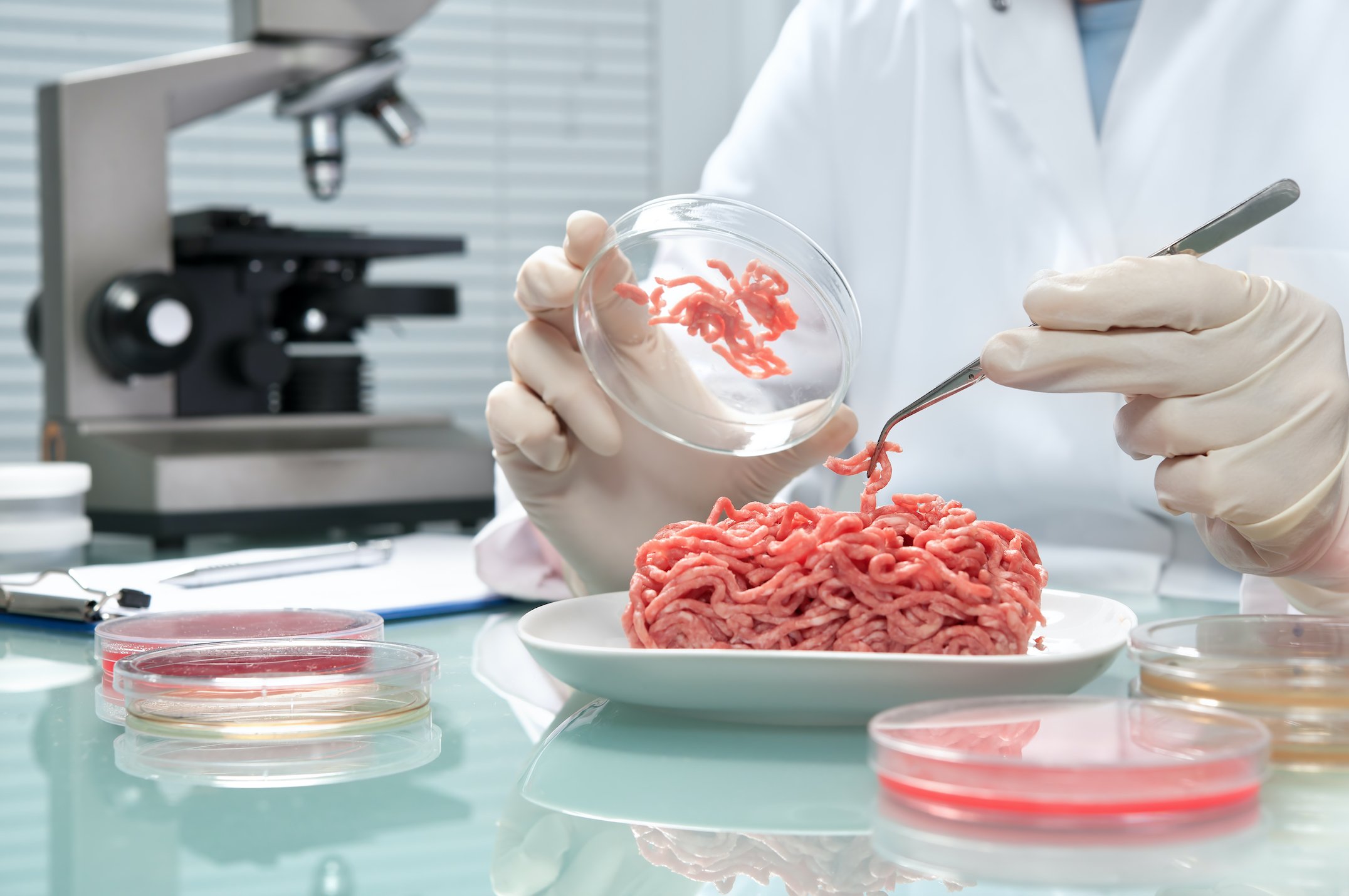
Finding a foreign object in food can quickly escalate from a singlecomplaint into a serious reputational and legal issue. Whether theclaim is genuine, accidental or malicious, you need fast, reliableanswers.
At Premier Analytical Services, we help you respond confidently byanswering the three critical questions:
- What is it?
- Where did it come from?
- How did it get there?
Need Immediate Assistance?
Contact our team today to discuss your foreign bodyinvestigation requirements. We are here to help yourespond quickly, professionally, and with confidence.
Need Immediate Assistance?
Contact our team today to discuss your foreign bodyinvestigation requirements. We are here to help yourespond quickly, professionally, and with confidence.
Accredited Quality You Can Trust
We offer 32 analytical methods accredited by UKAS to the ISO 17025standard, ensuring the highest level of technical competence and qualityassurance. This accreditation gives you confidence that every result isaccurate, defensible and suitable for regulatory or legal scrutiny.
A range of techniques are used, usually in combination, to identify both theforeign body and associated surface deposits, the presence of alpha amylase(present in saliva) when appropriate and to look for evidence of mechanicaldamage. Comparisons can be made with any reference materials supplied inorder to further investigate any possible sources and point of contaminationof the foreign material.
Accredited Quality You Can Trust
We offer 32 analytical methods accredited by UKAS to the ISO 17025standard, ensuring the highest level of technical competence and qualityassurance. This accreditation gives you confidence that every result isaccurate, defensible and suitable for regulatory or legal scrutiny.
A range of techniques are used, usually in combination, to identify both theforeign body and associated surface deposits, the presence of alpha amylase(present in saliva) when appropriate and to look for evidence of mechanicaldamage. Comparisons can be made with any reference materials supplied inorder to further investigate any possible sources and point of contaminationof the foreign material.
Clear, Comprehensive Reporting
You will receive:
- A report with discussions and conclusions
- Expert interpretation of findings
- Standard turnaround time is 5–8 working days from receipt of samplesand a valid P.O. number.
Reports are delivered:
- As a PDF via email
- Followed by a printed copy sent by recorded delivery (with the returnedsample)
- If your situation requires urgent action, we can provide an expeditedservice.
Energy Dispersive X-ray Analysis (EDX)
Identify unknown materials fast and accurately through their elementalcomposition.
Energy Dispersive X-ray Analysis (EDX) can distinguish a wide range offoreign bodies, including:
- Glass (heat-resistant vs. soda-lime)
- Metals and metal alloys
- Stainless steel types (200 & 300 series (austenitic), 400 series (ferritic))
- Bronze, brass, and other specialty alloys
- Dental amalgams and ceramics
- Tooth, bone and mineral fragments
EDX delivers precise elemental identification to help you determineexactly what you’re dealing with quickly and confidently.
Found an insect, spider, millipede or slug in your product? We canidentify it quickly and accurately using key physical features.
Our service includes:
- Species or group identification
- Insight into habitat, behaviour and lifecycle
- Assessment of likely contamination source
- Packaging damage examination to pinpoint entry points
- By combining specimen analysis with packaging inspection, wehelp determine how and when contamination occurred.
Alkaline Phosphatase Testing
- Alkaline phosphatase is an enzyme found in all livingorganisms. It becomes inactive at temperatures above~70°C.
- Testing for active alkaline phosphatase in insectsamples helps determine whether they have been heatprocessed.
Please note: This is a destructive test and requiressuitable sample conditions.
Found an insect, spider, millipede or slug in your product? We canidentify it quickly and accurately using key physical features.
Our service includes:
- Species or group identification
- Insight into habitat, behaviour and lifecycle
- Assessment of likely contamination source
- Packaging damage examination to pinpoint entry points
- By combining specimen analysis with packaging inspection, wehelp determine how and when contamination occurred.
Alkaline Phosphatase Testing
- Alkaline phosphatase is an enzyme found in all livingorganisms. It becomes inactive at temperatures above~70°C.
- Testing for active alkaline phosphatase in insectsamples helps determine whether they have been heatprocessed.
Please note: This is a destructive test and requiressuitable sample conditions.
Investigative Microscopy
Investigative Microscopy & Rheology for Food Structure, Texture & Performance
Appearance and texture are critical to consumer preference.
Both are governed by the underlying structure and flow behaviour of your product.
- Microscopical examination enables food structures to be visualised in detail, providing valuable insight into how raw ingredients and processing conditions influence final product characteristics. When complemented with rheological analysis, this structural understanding is strengthened by quantitative measurement of flow, deformation and viscoelastic behaviour.
At Premier Analytical Services, our investigative microscopy and rheology expertise helps you understand how ingredients and manufacturing regimes affect product appearance, texture and performance — enabling you to:
- Identify the root cause of product issues
- Improve product quality and consistency
- Optimise formulations and processing conditions
- Develop new products with targeted sensory attributes
- Correlate structure with measurable texture and flow properties
Supporting Problem Solving & Product Development
Microscopy and rheology together form a powerful toolkit for bothtroubleshooting and innovation across a wide range of foodproducts.
Understanding Ingredient & Process Effects
Clarifying how ingredient selection and processing parametersinfluence microstructure and flow behaviour — and how thesedrive texture and visual appeal.
Identifying Product Defects & Shelf-Life Issues
Investigating structural and rheological changes during productionand storage to determine root causes of defects or performancefailures.
Improving Manufacturing Efficiency
Evaluating structural integrity and flow properties to optimiseequipment performance and reduce waste.
Turn Insight Into Competitive Advantage
By combining structural analysis with rheological measurement,Premier Analytical Services delivers actionable insight to enhancequality, resolve technical challenges and accelerate productdevelopment.
Contact our team to discuss how our microscopy and rheologyexpertise can support your next project.
Examples of the techniques used:
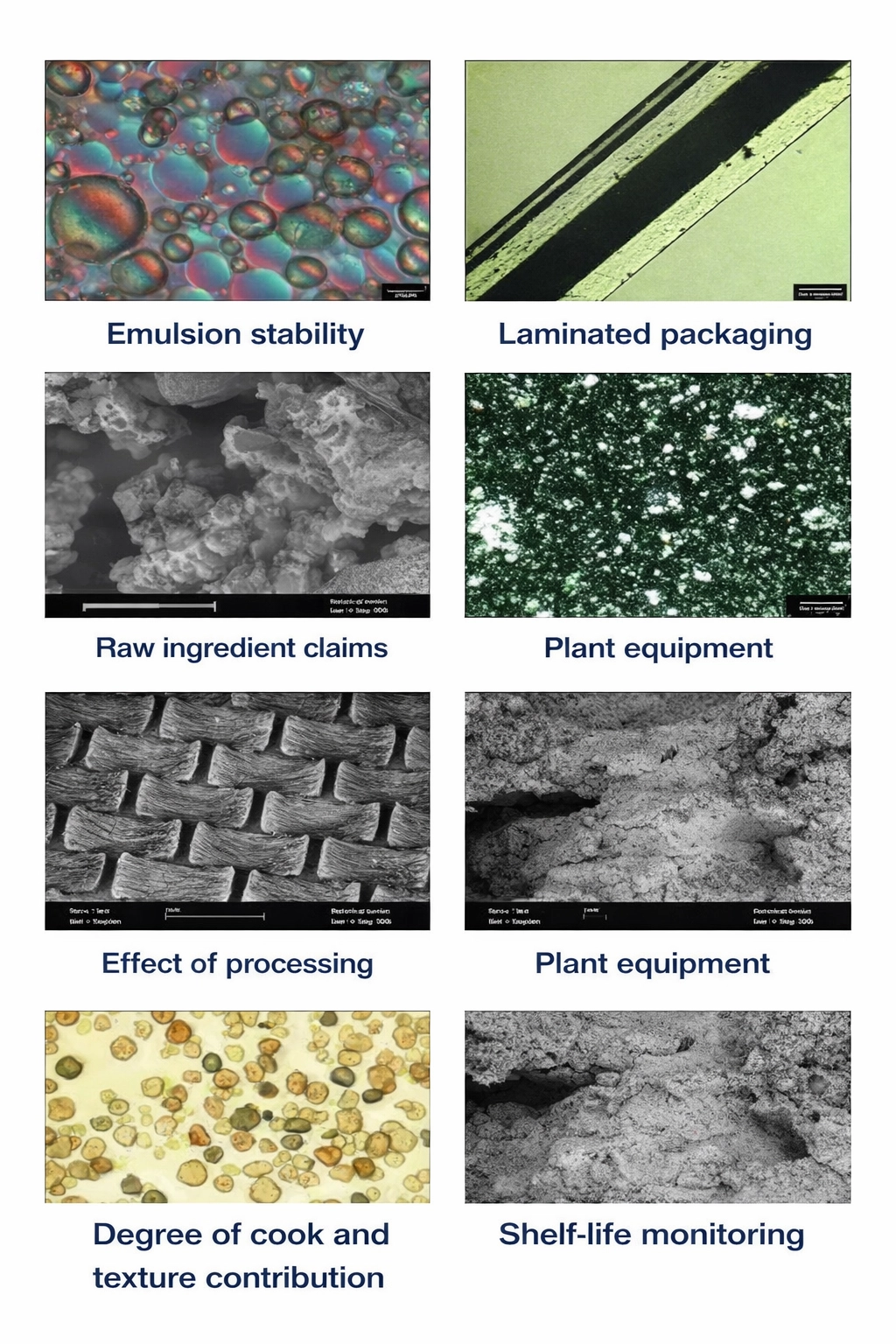
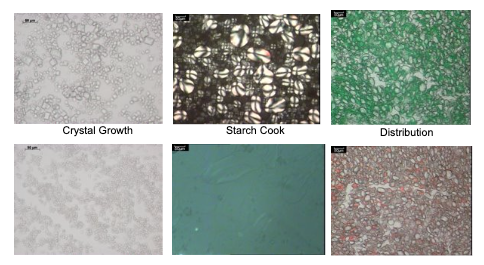
Optical microscopy – allows detailed identification of foreign bodies andstructural components in various materials. Both man-made andnatural fibres, wood fragments, rodent droppings, carbonised residues,insects, hair, and extraneous food particles can be distinguished basedon their morphological characteristics.
Using specific staining techniques, additional structural details can berevealed, providing valuable information on the presence, distribution,and nature of components such as starch, protein, fat/oil, cellular plantmaterial, and meat fibres. Optical microscopy enables the visualizationof structures and spatial arrangements of fats, proteins, starches,muscle fibres, gums, and hydrocolloids, offering a comprehensiveunderstanding of the material’s composition.
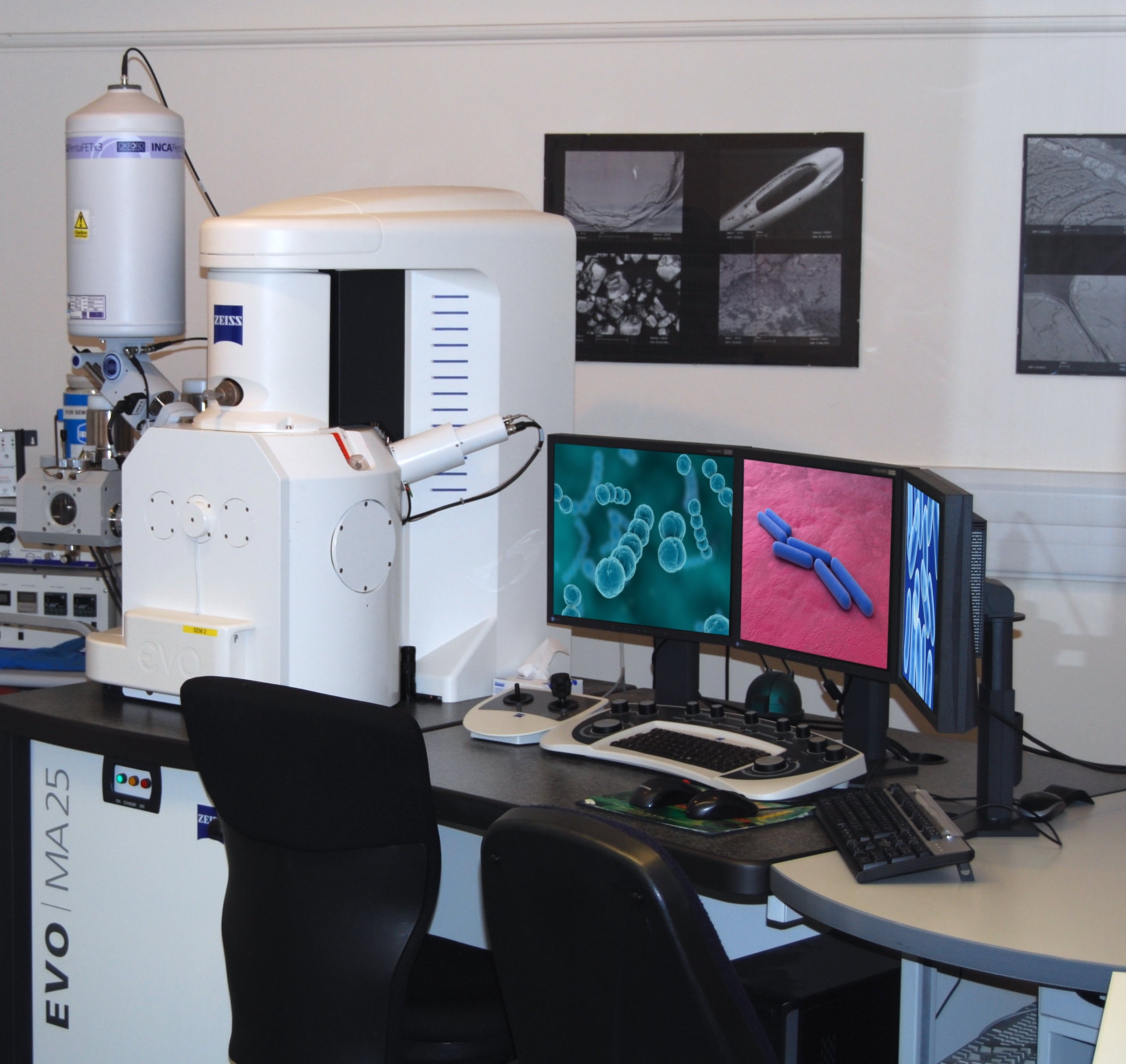
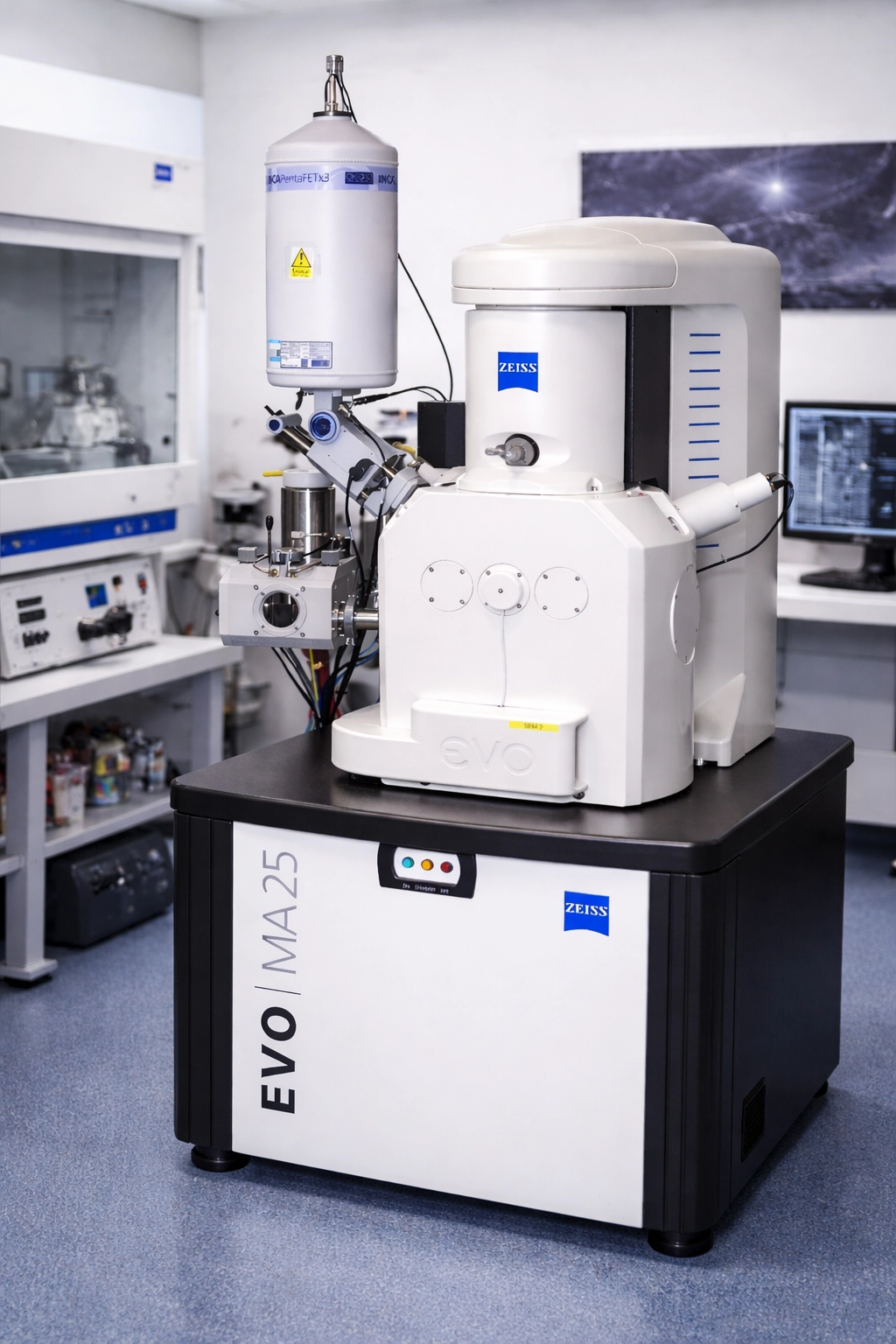
Scanning Electron Microscopy (SEM) – delivers high-resolution, topographical images that reveal the surface details of foreign objects including adhering deposits and how they’re distributed. It quickly highlights areas with different elemental compositions, helping identify possible contact with metals or dental materials when dental damage is alleged. SEM is also highly effective for detecting mechanical damage or evidence that a sample has been bitten.
Within investigative microscopy, both original and fracture surfaces of samples can be examined to provide valuable structural information relating to product appearance, aeration, density, and texture. Examination of fracture morphology can reveal how a material failed, whether through mechanical stress, impact, or bite action, while analysis of intact surfaces helps characterise manufacturing features and surface treatments.
Fast, precise, and non-destructive, SEM allows a wide range of samples to be imaged and analysed without compromising the integrity of the evidence.
Energy Dispersive X-ray Analysis (EDX)
Identify unknown materials fast and accurately through their elementalcomposition.
Energy Dispersive X-ray Analysis (EDX) can distinguish a wide range offoreign bodies, including:
- Glass (heat-resistant vs. soda-lime)
- Metals and metal alloys
- Stainless steel types (200 & 300 series (austenitic), 400 series (ferritic))
- Bronze, brass, and other specialty alloys
- Dental amalgams and ceramics
- Tooth, bone and mineral fragments
EDX delivers precise elemental identification to help you determineexactly what you’re dealing with quickly and confidently.
Energy Dispersive X-ray Analysis (EDX)
Identify unknown materials fast and accurately through their elementalcomposition.
Energy Dispersive X-ray Analysis (EDX) can distinguish a wide range offoreign bodies, including:
- Glass (heat-resistant vs. soda-lime)
- Metals and metal alloys
- Stainless steel types (200 & 300 series (austenitic), 400 series (ferritic))
- Bronze, brass, and other specialty alloys
- Dental amalgams and ceramics
- Tooth, bone and mineral fragments
EDX delivers precise elemental identification to help you determineexactly what you’re dealing with quickly and confidently.

Energy Dispersive X-ray Analysis (EDX)
Identify unknown materials fast and accurately through their elementalcomposition.
Energy Dispersive X-ray Analysis (EDX) can distinguish a wide range offoreign bodies, including:
- Glass (heat-resistant vs. soda-lime)
- Metals and metal alloys
- Stainless steel types (200 & 300 series (austenitic), 400 series (ferritic))
- Bronze, brass, and other specialty alloys
- Dental amalgams and ceramics
- Tooth, bone and mineral fragments
EDX delivers precise elemental identification to help you determineexactly what you’re dealing with quickly and confidently.
Fourier Transform Infrared (FTIR) Spectroscopy
Uncover what your material is made of.
FTIR provides information about the chemicalcomposition of materials by producing a spectral“fingerprint.”
Match results against extensive spectral libraries toidentify a wide range of materials from plastics,elastomers and food products to man-made fibres andmore.
Fourier Transform Infrared (FTIR) Spectroscopy
Uncover what your material is made of.
FTIR provides information about the chemicalcomposition of materials by producing a spectral“fingerprint.”
Match results against extensive spectral libraries toidentify a wide range of materials from plastics,elastomers and food products to man-made fibres andmore.
The structures existing in raw ingredients affect how they process and their contribution to final product attributes. The selected processing regime can have a dramatic effect on the structure of the product components and therefore the texture/appearance of the final product.
Microscopy can aid in understanding raw ingredients and the structural changes they undergo through processing. Such information can then be used to optimise both processing efficiency and product quality. Microscopy can also be used to confirm some supplier’s ingredient claims.
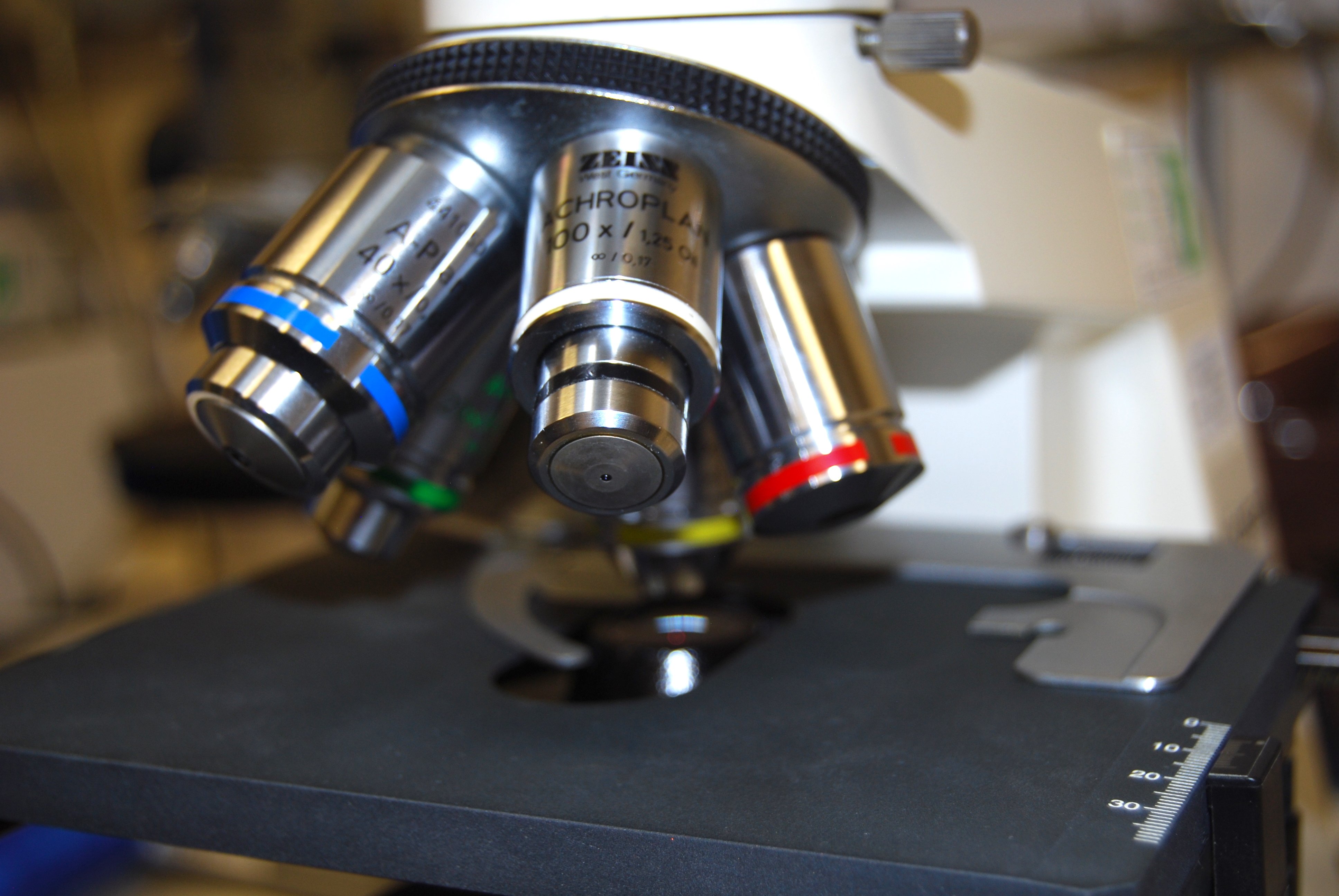
A controlled heating stage allows heating processes to be mimicked on the optical microscope and changes to the sample structure monitored.
Final Product Quality – Appearance and Texture
An undesirable product appearance or texture, leading to poor product perception, can form during manufacture or develop over shelf-life. Achieving and maintaining the desired product attributes is therefore important. Identifying the cause of an unwanted characteristic is the first step to delaying or inhibiting its formation through reformulation, process changes or storage conditions.
Microscopical examination over the desired product shelf-life can allow the occurrence of undesired structural changes to be identified sooner, shortening the duration of unsuccessful shelf-life trials.
Equipment Assessment
The surface structures of processing equipment can affect product adhesion and release and therefore parameters such as process throughput. Examination of such equipment surfaces can help to explain their performance and be useful in the identification, or design, of better alternatives prior to their use / assessment on line.
Packaging Structure and Composition
Microscopy can be used to determine the structure of packaging materials, including cross-sectional and surface structures and seal formation. The additional use of Fourier transform infrared spectroscopy determines the composition of polymer type packaging materials. The results obtained can be searched against our libraries of reference spectra to determine the polymer type.